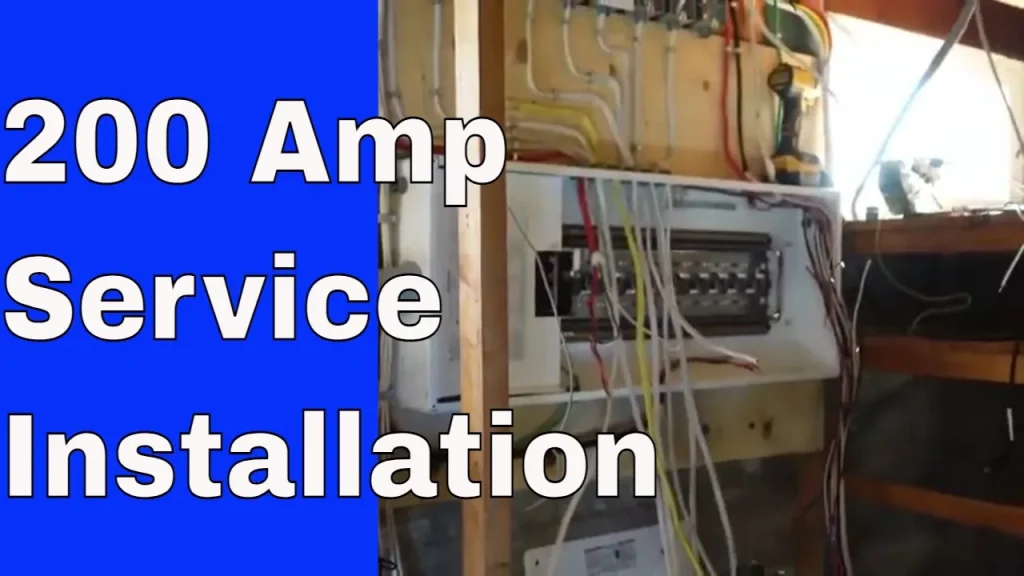
Today’s question is: Does outlet amperage matter?
Short answer—yes, absolutely.
Stick around and we’ll show you why.
Understanding Outlet and Breaker Ratings
In your home, every outlet type is paired with a specific wire size and breaker rating for a reason.
- 15-amp receptacle: Your standard household plug.
- 20-amp receptacle: Often found on kitchen countertops.
- 30-amp receptacle: Common for dryers.
- 40–50 amp receptacles: Used for stoves, welders, and other heavy appliances.
Each of these circuits uses different wire sizes and different protection levels, and you cannot mix and match them.
To show this clearly, we set up a small demonstration with four circuits:
- A 15-amp breaker, 15-amp wire, and 15-amp outlet—the most common setup in homes.
- A 20-amp breaker, 20-amp wire, and 20-amp outlet like those on kitchen counters.
- A 30-amp breaker feeding 10-gauge dryer wire for a 30-amp outlet.
- A 50-amp breaker with 50-amp wire and a 50-amp receptacle. (In Canada, sometimes this is 40 amps.)
Everything here is sized correctly—breaker, wire, and outlet all match. And that’s exactly how it must be installed.
Why You Can’t Mix and Match
We’ve seen some scary things over the years. For example, someone installing a dryer receptacle on 14-gauge wire. That wire is only rated for 15 amps, but a dryer might try to pull 30 amps or more.
Here’s what happens:
- The dryer tries to draw 30 amps.
- The breaker allows 30 amps.
- The wire can only handle 15 amps.
- The wire overheats… and you risk burning your house down.
This is exactly why outlet amperage matters—because the overcurrent protection (the breaker) must match the wire size, not just the receptacle.
If the breaker is too big for the wire, the breaker won’t trip soon enough, and the wire becomes your fuse… a fuse that burns inside your walls.
When Larger Wire Is Okay
There are situations where you can safely use larger wire on a smaller breaker.
For example:
- Using dryer-gauge wire on a 15- or 20-amp breaker during a temporary service setup.
This works because you are not under-protecting the wire. The breaker limits the current to a safe level.
However, this isn’t something we do unless absolutely necessary, and it’s not common practice for permanent installations.
The Rule You Must Never Break
Never, ever under-protect the wire.
The breaker’s job is to protect the wire.
The wire’s job is to safely carry the load.
The receptacle simply limits what can be plugged in.
If the breaker is rated higher than the wire, the wire becomes the weakest link—and that’s where things get dangerous.
Leave Electrical Work to Professionals
Although all this may sound straightforward, electrical safety is serious. Always use a certified electrician, and never mix and match outlet and breaker amperages. They are designed a certain way for a reason.
- The amperage is the amount of current being pulled.
- The voltage is what pushes it through the circuit.
- The wire size determines how much current it can safely carry.
Make sure every part of the circuit is properly rated.
Thanks for Watching
Hope you enjoyed this breakdown!
If you want more videos like this, check the link in the corner or visit our website where all our videos are neatly organized and searchable.
Stay safe out there, and don’t forget to like and subscribe.
We’ll see you next time!